
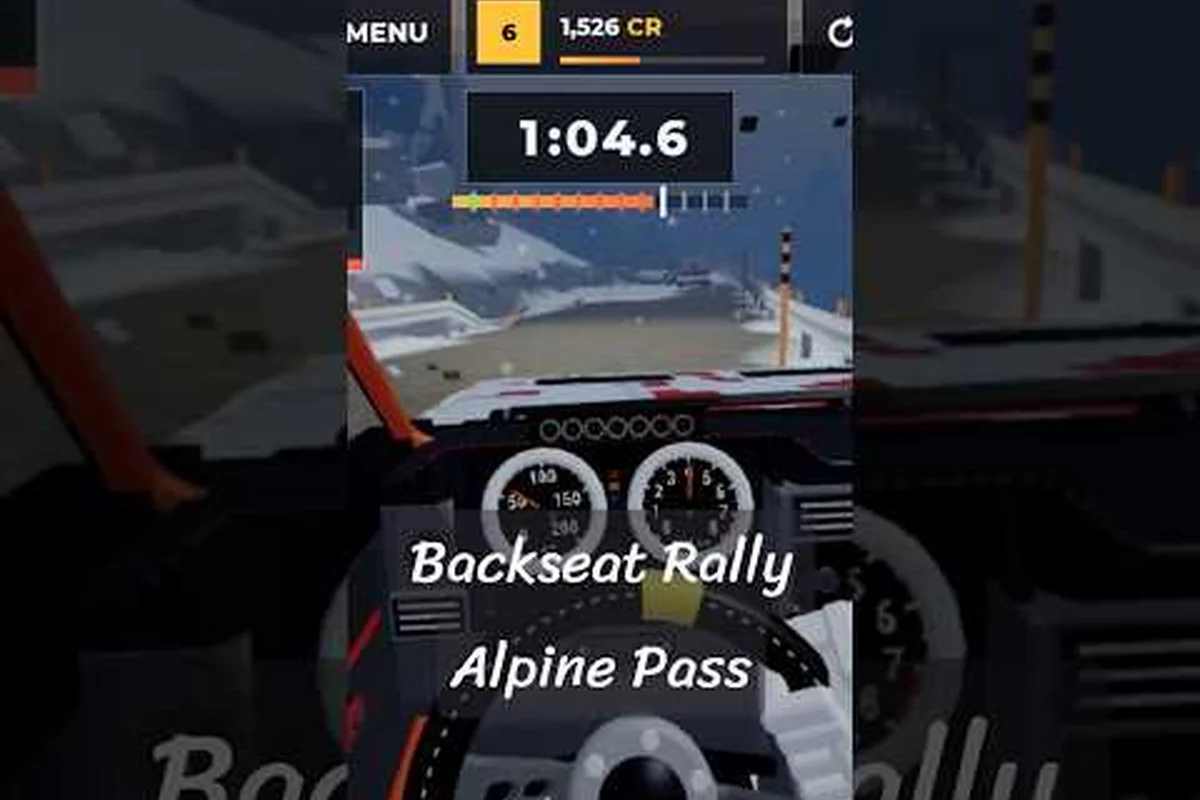
Backseat Rally winter driving rewards patience, clear communication, and smooth inputs when grip changes. Learn how to handle snow, rain, wet roads, and mud without wasting speed on abrupt steering or braking.
Backseat Rally Winter Driving: Core Weather Mechanics
Backseat Rally winter driving is less about raw acceleration and more about preserving control between checkpoints. Snow, rain, and mud can reduce the amount of useful traction available, so a rally that looks clear may still demand a completely different approach from a dry forest stage. The official Backseat Rally game page identifies five stages, including snowy passes, a rain stage, and a mud cross, with dynamic conditions that alter grip and braking during runs.
That weather variety makes Backseat Rally weather stages more than a collection of visual changes. Each surface asks the driver and co-driver to communicate differently, because the same corner can be forgiving on dry pavement and dangerous when water, snow, or mud reaches the tires. The Backseat Rally Guide by ItzVexo emphasizes the two-role system and learning the co-driver’s turn and distance warnings, which is especially valuable when visibility or road detail is limited.
| Weather condition | Main handling concern | Best first adjustment | Skill to preserve |
|---|---|---|---|
| Snow | Low grip and long braking distance | Reduce entry speed | Smooth throttle and steering |
| Rain | Reduced visibility and hydroplaning risk | Brake before the corner entry | Calm camera discipline |
| Wet road | Soft response to steering input | Use smaller steering corrections | Patient acceleration |
| Mud | Uneven traction and poor acceleration | Keep momentum without abrupt inputs | Early line selection |
The central rule is simple: change your inputs before the surface demands it. A sudden steering input may feel necessary when a slide develops, but it can consume the remaining grip and make recovery less predictable. Smoothness, earlier braking, and matching the car’s direction before adding power are the foundation of a clean cold-weather run.
How Weather Changes the Driving Problem
Dry stages reward a direct rhythm: look through the corner, choose a line, turn, straighten the wheel, and accelerate. Weather stages separate that rhythm into smaller decisions because braking, turning, and power can each exceed the available grip. A driver who enters with the same speed as on a dry road may still be technically correct, yet physically unable to maintain the intended path.
The co-driver’s role becomes more valuable because early information is easier to use. A warning delivered before the tightest part of a corner gives the driver time to release the accelerator, settle the car, and prepare for the turn. When a call arrives after the car is already sliding, both players lose the small adjustment window that could have prevented a spin.
| Driving phase | Dry-stage habit | Winter-stage revision | Why it helps |
|---|---|---|---|
| Before a turn | Carry speed toward the braking point | Brake earlier and release throttle | Limits the chance of locking or losing grip |
| At turn entry | Turn and accelerate together | Rotate gently, then add power | Prevents abrupt load transfer |
| Mid-corner | Correct toward the apex | Hold a stable steering angle | Limits instability on low-grip surfaces |
| Corner exit | Accelerate as soon as possible | Increase power gradually | Prevents wheelspin on snow or mud |
For a broader explanation of how changing surfaces affect grip, braking, and visibility, use the Backseat Rally weather guide. Its principles are useful even when a specific run begins on a stage that looks bright and clear, because weather stages can change as the event continues.
Backseat Rally Snow Driving Tips for Clean Corners
Backseat Rally snow driving tips center on momentum control, because packed snow can make sudden acceleration feel harmless while braking and steering remain the real danger. A car may still move when the wheels are spinning, yet stopping distance and directional stability can deteriorate sharply. Drivers should therefore treat a snowy stage as a precision exercise rather than a test of forceful inputs.
A useful routine is to separate the stage into three braking zones. First, identify the corner and its probable severity from the co-driver’s call. Second, release the accelerator and apply controlled braking before turn entry. Third, keep the steering light, aim through the corner, and add only enough throttle to keep the car moving smoothly.
| Snow situation | Likely symptom | Driver response | Co-driver response |
|---|---|---|---|
| Early turn warning | Enough time to prepare | Brake and settle the car | Give the direction and distance clearly |
| Late turn warning | Car still carrying speed | Avoid hard steering; regain control first | Repeat the most useful warning concisely |
| Visible white or icy patch | Local grip change | Ease off and cross it squarely | Warn about the immediate surface change |
| Car begins to slide | Direction no longer follows input | Countersteer gently and avoid added power | Avoid flooding the driver with extra noise |
| Exit opens onto a rise | Blindness or crest effect | Keep speed controlled until the road is visible | Emphasize the hazard ahead |
Snow entry rhythm is the most useful term for this routine: prepare, rotate, then drive. Prepare by shedding speed early, rotate by using a small steering angle, and drive by feeding in modest power only after the car is pointing through the corner. This approach gives the co-driver’s call a clear purpose instead of turning the run into a reaction test.
Players should also avoid a single fixed speed target for the entire stage. The same corner can offer more grip on a shaded section and less on an exposed patch, while the car’s behavior can change after a previous slide has disturbed the surface. A good driver watches the available road evidence and updates the target continuously.
Snow Stage Checklist
Before starting a cold run, confirm several practical settings and expectations. These steps do not change the official handling values, which are not specified on the public game page; they instead help the player communicate consistently.
-
Co-driver call order: establish whether distance comes before direction or after it, because both players need the same timing.
-
Braking reference: choose a recognizable road feature as the braking marker for repeated corners.
-
Slide recovery cue: agree on one clear action, such as releasing all inputs, so the driver does not add conflicting corrections.
-
Weather changes: check whether the stage reports rain, snow, or mud before the run begins, because a weather transition can change the plan for later sections.
-
First-pass objective: aim for clean control and accurate calls rather than a personal-best time.
| Score priority | Why it matters in snow | Better example |
|---|---|---|
| Clean direction | Preserves the available grip | Small, early steering corrections |
| Smooth braking | Reduces lockup and instability | Brake before the turn rather than during it |
| Communication | Helps the driver prepare | Specific distance plus direction call |
| Recovery | Limits compounding errors | One correction at a time |
The official page lists a snowy pass among the launch-stage environments, so this is a core part of the rally rather than an optional visual variation. Community experience also supports the emphasis on call timing: the nocrown PC guide highlights camera behavior, steering, braking, and co-driver audio as settings worth understanding before chasing better stage results.
Rain and Wet Weather Control Techniques
Backseat rally wet weather tips combine the visibility problem of rain with the traction problem of standing water. Water on the road can soften braking, while reflections can make road edges and obstacles harder to read. The co-driver should describe hazards early and use simple location words, because complicated phrasing may distract the driver at the exact moment extra attention is required.
Rain also changes how aggressively the driver should use the camera. Looking farther ahead helps identify a brake point, but a narrow view of the road immediately ahead remains critical for judging whether the car is pointing where the driver intends. Players using PC can compare camera and callout behavior with the nocrown keyboard-and-mouse guide, which discusses how desktop controls affect precision.
| Wet-road risk | Driver technique | Co-driver technique | Result |
|---|---|---|---|
| Standing water | Brake progressively before the puddle | Call the water and its position | Less abrupt speed change |
| Poorly visible corner | Keep the car within a readable speed range | Emphasize the turn’s severity | More preparation time |
| Spray from another vehicle | Maintain a stable line and avoid sudden inputs | Report nearby traffic clearly | Lower chance of a secondary slide |
| Road reflection | Use road edges and signs as reference points | Describe the exact hazard | Better judgment of position |
| Long straight | Keep the wheel settled | Avoid unnecessary speed calls | More stable high-speed run |
Backseat Rally rain stage tips are most effective when they reduce confusion. Rather than rapidly repeating a call, the co-driver should provide the essential information in a predictable sequence: hazard, distance, direction, and consequence if the driver is still too fast. A concise call gives the driver time to process it, whereas a long explanation can hide the one word that matters most.
A Four-Part Wet-Road Decision
Use a four-part decision whenever the car enters a wet section. First, determine whether the road is merely damp or visibly flooded. Second, estimate the distance to the next braking point. Third, check whether the corner will require an early release of the accelerator. Fourth, decide whether the current car speed permits a smooth input sequence.
This process keeps wet-road priorities ordered: visibility, straight-line control, corner entry, and power. Trying to solve all four at once can create conflicting actions, especially if the driver brakes hard while also correcting the car’s direction. Completing one stage of the decision at a time gives the tires a more coherent task.
| Situation | Avoid | Prefer |
|---|---|---|
| Before a wet corner | Last-second hard braking | Early, progressive braking |
| While turning | Large steering corrections | Small corrections toward the intended line |
| On a crest | Accelerating before visibility improves | Keeping the car settled until the road appears |
| In standing water | Sudden throttle after the puddle | Smooth power on a drier section |
| During traffic | Chasing the vehicle ahead | Maintaining a safe gap and own line |
Rain is one of several conditions used to make the rally’s stages distinct. The Backseat Rally stage-weather overview explains how environment changes can affect a run, while the tactics here focus on turning those changes into a repeatable driver-and-co-driver routine.
Mud Stage Strategy for Momentum Control
Backseat Rally mud stage tips address a surface where the relationship between throttle, speed, and grip becomes less predictable. Mud can reduce acceleration, disturb the line, and leave the car searching for purchase. While a driver cannot create traction where none exists, they can avoid wasting it with abrupt steering, sudden power, and unnecessary corrections.
The key is to preserve momentum. Stopping in deep mud is expensive because the car may need to rebuild speed on a surface offering little resistance. That does not mean entering every bend at maximum speed; it means committing to a realistic line, cleaning up the entry, and using controlled throttle so the car does not stall or spin.
| Mud-stage phase | Objective | Input discipline | Likely mistake to avoid |
|---|---|---|---|
| Approach | Select a stable, firmer line | Reduce abrupt steering | Chasing an ideal line too late |
| Turn entry | Carry only usable speed | Brake before the turn if needed | Entering while the car is still sliding |
| Mid-corner | Maintain direction | Hold a consistent angle | Constantly changing steering |
| Corner exit | Rebuild momentum | Apply power in small steps | Slamming the accelerator |
| Rut or rough patch | Cross without destabilizing the car | Keep the wheel moving smoothly | Fighting a small camera wobble |
Momentum preservation is the defining concept. If the car is already rotating correctly through a muddy corner, a burst of throttle can break that balance and create unnecessary work. A driver who waits for the tires to regain grip often produces a cleaner exit, even if the recovery appears slower at first.
The mud stage also rewards co-driver restraint. When the driver is trying to stabilize a sliding car, repeated calls can make it harder to focus on the road. A useful warning system is tiered: immediate danger first, then turn information, then context. This lets the driver prioritize the action that prevents a crash while preserving the remaining navigation cues.
Choosing a Mud Recovery Strategy
There are three common recovery situations. The first is a slow car with a stable direction. The driver should select moderate throttle and allow the car to build speed without turning the input into a dramatic wheelspin. The second is a sideways car with ample distance. Gentle countersteering and reduced throttle can help it settle. The third is a sideways car near an obstacle. Here, preserving control matters more than speed; the co-driver should identify the immediate boundary and let the driver prioritize straightening the car.
| Recovery state | Best action | Why it works |
|---|---|---|
| Stable but slow | Add measured throttle | Keeps wheels from spinning while rebuilding speed |
| Slight slide | Reduce power and hold direction | Prevents the slide from worsening |
| Strong slide | Apply gentle countersteer | Recovers directional control without a sudden flick |
| Near a wall or tree | Brake and straighten if possible | Limits impact severity while giving the driver options |
| Deep rut | Keep steering smooth | Reduces the chance of snagging the car’s path |
The launch content on the official game page includes both a mud cross and a rain stage, confirming that players must adjust for materially different surfaces rather than simply changing their target times. For broader handling fundamentals, compare this approach with the Backseat Rally low-grip guide, which focuses on the relationship between slippery surfaces and driver control.
Weather Stage Tactics for Driver-Co-Driver Teams
Backseat Rally weather stages demand communication as much as they demand control. The driver cannot see the full road, and the co-driver cannot compensate for poor steering or excessive speed simply by calling more information. Strong teams assign each player a clear responsibility: the driver controls the car, while the co-driver keeps the driver informed early and precisely.
A useful call system has four elements. Identify the hazard, state its distance, give the direction, and explain the required action only when necessary. For example, “left, close, tight” may be more effective than a complete sentence during a fast bend. In a slower section, the co-driver can add context, but consistency across the run is what allows the driver to recognize urgent information instantly.
| Call element | Example | Driver response | Best used when |
|---|---|---|---|
| Direction | “Left” | Prepare the steering input | Every meaningful turn |
| Distance | “Close” | Brake and reduce speed | The corner is approaching quickly |
| Severity | “Tight” | Make the line conservative | The corner has limited room |
| Hazard | “Water left” | Avoid the affected section | A localized weather patch appears |
| Traffic | “Car right” | Hold the current line and leave space | Another vehicle is nearby |
Call hierarchy keeps the co-driver’s message intelligible. Immediate collision threats outrank terrain details, while distance and severity should be linked whenever possible. Saying “close left, tight” is often clearer than delivering a direction and severity in separate moments, because the driver can immediately combine both facts into a braking plan.
Rehearsing a Cold-Weather Stage
Rehearsing is more useful than repeatedly making the same mistake. After a failed run, identify the first point where the car became unstable. Was it an early turn warning that produced late braking? Did the driver miss a wet patch? Did the co-driver overdescribe a simple corner? The answer determines which part of the routine needs correction.
| Failure point | Diagnostic question | Corrective action |
|---|---|---|
| No braking before the corner | Did the driver wait for the call? | Have the co-driver give distance earlier |
| Sudden steering at entry | Was the speed still too high? | Use a firmer braking reference |
| Wheelspin on exit | Was power added before alignment? | Delay and grade throttle |
| Car hit a muddy patch | Was the hazard not communicated? | Add consistent local-hazard calls |
| Wrong turn | Was direction unclear? | Repeat the established call order |
Team practice should be short and specific. Complete a few clean runs focusing only on braking markers, then repeat with attention on throttle. Trying to change braking, steering, communication, and racing line simultaneously often creates confusion, whereas staged practice isolates one variable at a time. A community guide from CHALLS highlights launch timing and line choice as separate performance areas, and the same principle applies to weather practice.
Building a Consistent Pre-Run Routine
A routine reduces pressure and makes weather execution more repeatable. Check the active stage and current conditions, confirm the co-driver’s call order, identify the first familiar corner, and decide the target for the first attempt. Avoid placing all emphasis on the medal target; a failed run often reveals a communication or braking problem more clearly than a successful cautious run.
| Routine stage | Driver task | Co-driver task |
|---|---|---|
| Before start | Check controls and car stability | Review turn directions and hazards |
| Opening straight | Build speed evenly | Give early weather and corner notes |
| First corner | Follow the established braking reference | Confirm whether the entry was early enough |
| Mid-stage | Maintain smooth inputs | Use consistent severity and distance terms |
| Final section | Avoid unnecessary risks | Announce the finish and remaining hazards |
| After finish | Review the first unstable moment | Compare the call with the car’s response |
Stage-specific planning prevents a successful dry-stage routine from becoming a poor cold-weather habit. Keep the overall structure, but change the braking points, expected acceleration, and communication density. The Backseat Rally off-road stage overview can help separate environmental challenges from stage-specific elements such as route layout, difficulty, and medal goals.
Advanced Winter Driving: Recoveries, Lines, and Consistency
Advanced Backseat Rally winter driving depends on deciding which problem deserves attention first. When the car slides, is the immediate issue direction, speed, or a nearby obstacle? Treating every disturbance as a steering problem can worsen the recovery. A more effective hierarchy is safety, direction, speed, and finally power.
Weather also changes the usefulness of racing lines. The shortest line may pass over snow, deep mud, standing water, or a rough patch, while a slightly wider route may offer more grip. That does not mean avoiding every hazard at any cost, because excessive line changes consume time and increase risk. Instead, compare the available line with the co-driver’s information and choose the one that supports a controlled exit.
| Situation | First priority | Secondary priority | Avoid |
|---|---|---|---|
| Light slide on an open road | Direction and grip | Rebuilding speed | Abrupt countersteer |
| Slide near a tree or wall | Avoiding impact | Recovering speed | Steering toward the obstacle |
| Deep water at corner entry | Reducing speed | Selecting a stable line | Entering while still accelerating |
| Muddy exit | Keeping the car aligned | Applying power | Full-throttle wheelspin |
| Poor visibility crest | Controlling speed | Reading the next corner | Accelerating before seeing the road |
Recovery hierarchy is a useful team phrase. When the driver is struggling, the co-driver can internally rank the problems and offer only the most useful information. “Tree left” may matter more than “right bend” when the car is sliding toward the tree. Once the immediate danger is resolved, the co-driver can resume normal navigation.
Consistency also comes from recording why a run failed. A single clean lap is difficult to evaluate after a crash, so track the first error rather than only the final time. If the same corner causes trouble across several attempts, the solution may be a new braking marker or call format. If every corner causes trouble, the issue may be excessive entry speed or difficulty reading the road.
A Simple Repeatability Test
Run the same stage under comparable conditions and record four values: the number of severe slides, the number of missed calls, the first unstable corner, and whether the finish was clean. This creates a more meaningful measure than a single time because weather stages can make conditions less consistent.
| Measure | What it reveals | Useful response |
|---|---|---|
| Severe slides | Whether entry speed is too high | Move the braking marker earlier |
| Missed calls | Whether communication order is inconsistent | Rehearse the call sequence |
| First unstable corner | Whether a specific feature causes trouble | Change the line or warning format |
| Clean finish | Whether the routine is stable | Keep the successful reference points |
| Repeated late braking | Whether calls arrive too close together | Ask for earlier distance warnings |
The official Backseat Rally page identifies seven unlockable cars and five stages in the launch lineup, giving players a compact test set for comparing conditions. A vehicle that feels stable on the rain stage may still behave differently on the snow route, so treat each environment as its own baseline instead of assuming one car setup solves every surface.
Frequently Asked Questions
What is the best approach for Backseat Rally winter driving?
The best approach is to preserve grip by braking before corners, using small steering inputs, and adding throttle only after the car is aligned. The driver should prioritize direction and safety before speed, while the co-driver calls distance, direction, and severity early. Smooth, repeatable inputs are more valuable than rapid corrections.
Should I brake earlier on Backseat Rally snow stages?
Yes. Snow can increase braking distance and reduce steering response, so braking earlier allows the car to settle before turn entry. Aim for controlled deceleration rather than a sudden stop, and avoid steering sharply while the tires are still sliding. A consistent braking reference helps the driver apply the same technique on repeated attempts.
What are the most useful Backseat Rally rain stage tips?
Reduce speed before wet corners, keep the camera settled, and watch road edges for visual reference. The co-driver should warn about standing water and tight turns before the driver reaches them. Drivers should also avoid sudden power when crossing a puddle, since the tires may regain or lose grip as they leave the wet surface.
How do I recover when my car slides in mud?
First, ease off excess throttle and determine whether nearby obstacles create immediate danger. If there is room, use gentle countersteering and hold a consistent steering angle until the car regains direction. If a tree or wall is close, protecting the car from impact matters more than restoring speed immediately.
Can the co-driver fix mistakes caused by excessive speed?
No. A co-driver can provide earlier and clearer warnings, but the driver must still reduce speed and correct the car’s movement. Better call timing prevents some errors, while a consistent call order makes them easier to act on. Teams should review the first unstable moment after each run to separate a communication problem from a driving-speed problem.