
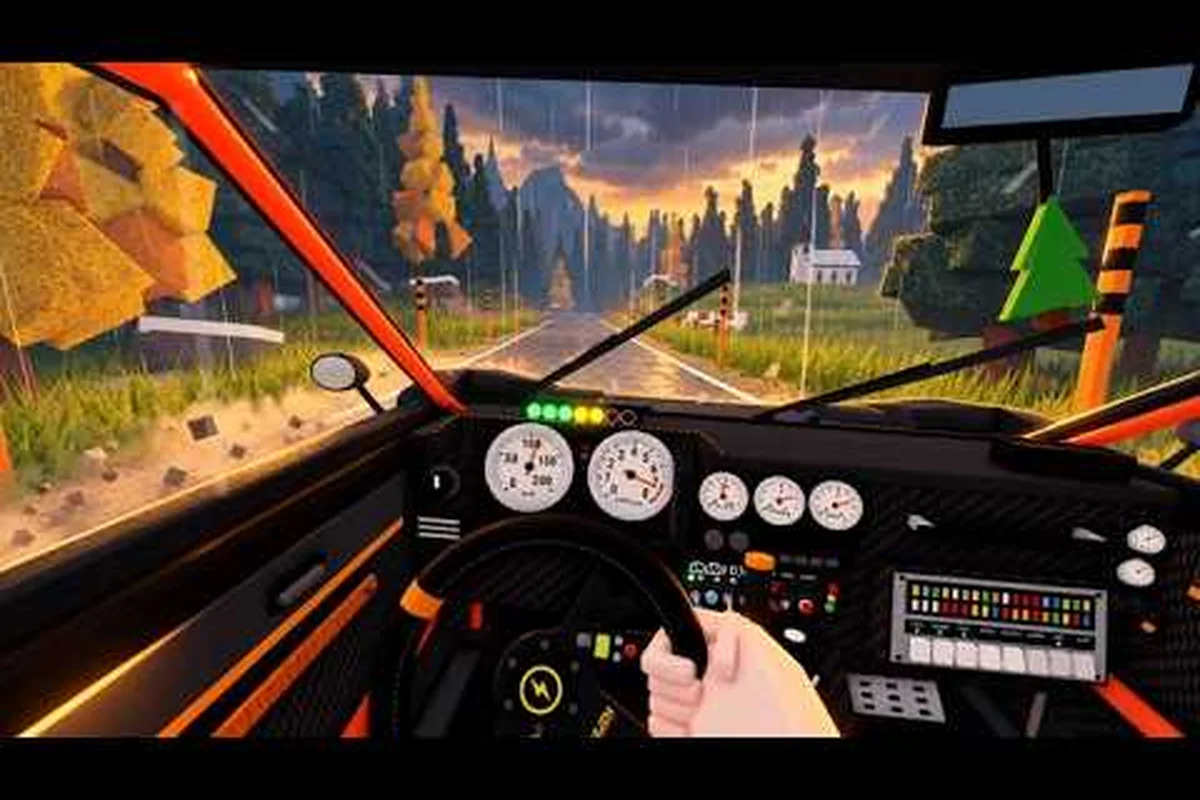
Backseat Rally rewards quick decisions, precise driving, and trustworthy teamwork, so this Backseat Rally complete guide explains the full system from your first stage to advanced races. Master the controls, cars, tuning, callouts, and progression route that turn scattered practice into faster, cleaner finishes.
Backseat Rally Getting Started: Controls, Roles, and First Races
Backseat Rally is a two-role driving game in which one player steers and another reads the road to provide directions. That division makes the Backseat Rally getting started process more about communication than memorizing a long list of buttons. The PC controls walkthrough by nocrown also demonstrates how camera position, steering, braking, and callout audio behave on desktop, which is especially useful before attempting competitive stages.
A typical rally stage follows a clear sequence. You enter a race, choose or join a vehicle, begin at the start line, and navigate a course while collecting Credits. At the finish, your placement and completion time determine the result. Repeated stages let you learn corners, hazards, and vehicle characteristics, while multiplayer matches add a stronger incentive to improve.
The two-player system
The driver handles the physical operation of the car. The co-driver watches the road, calls upcoming turns, warns about obstacles, and may provide distance or timing information. Early AI assistance or clearer co-driver prompts can make the first attempts easier, but human partners usually create a more flexible rhythm because both players can adapt in real time.
| Role | Main responsibility | Common mistake |
|---|---|---|
| Driver | Steering, braking, acceleration, and car control | Looking at distant scenery instead of the road immediately ahead |
| Co-driver | Reading turns, hazards, and distance cues | Giving vague calls too late to react to |
| Solo player | Driving while interpreting the co-driver's spoken prompts | Treating a prompt as a button press rather than useful information |
| Team player | Coordinating timing, line, and trust | Talking over each other during critical corners |
The Backseat Rally trust game guide explains the relationship side of the format in greater detail, especially why a co-driver should issue concise instructions and why consistent phrasing matters. In practice, a call such as “left, tightens, maybe 30” gives the driver a usable timeline and severity signal, whereas “watch out” forces the driver to guess both the direction and distance. Repeating a fixed vocabulary for hazards and corner intensity helps a new player learn the co-driver’s language, reduces mid-corner corrections, and turns the two-player system into a faster feedback loop without adding more spoken detail.
Essential early controls
Before racing, map every control to the action it produces: steering should move the car, throttle should accelerate, and brake should slow it without reversing the response. A quick controls test in a wide practice area can reveal whether a stick, keyboard, or controller needs adjustment before a tight corner forces you to react. If you are learning how to play Backseat Rally on Roblox, treat the setup routine below as a baseline for learning its co-driver calls, countdown sequence, and race handling.
-
Confirm that steering responds predictably and does not feel inverted.
-
Test the brake because precise stops are often safer than dramatic slides.
-
Keep the camera far enough ahead to see the next corner without losing sight of the car.
-
Listen for co-driver calls during the countdown and first turn.
-
Use the AI co-driver until you understand the available callout types.
-
Change one setting at a time so you can identify whether an adjustment improved control.
Your first progression loop
The most effective early loop is simple: race, earn Credits, improve the car, and repeat. Community walkthroughs report that the garage becomes available after the first stage, while head-to-head lobbies can provide a small Credits boost. That extra income is especially helpful because it accelerates access to stronger cars without requiring a risky spending strategy.
| Stage | Goal | Best learning focus |
|---|---|---|
| First solo stage | Learn the control rhythm | Gentle corners, braking distance, and callout timing |
| Early repeat runs | Build familiarity | Memorize the course and reduce wasted braking |
| Garage stage | Compare vehicle options | Acceleration, grip, and handling by terrain |
| Head-to-head match | Test racecraft | Clean racing, overtaking, and consistency |
| Advanced stages | Chase better results | Vehicle tuning and optimized lines |
A Backseat Rally starter guide can serve as a compact practice reference while this guide covers the broader system. Most importantly, resist changing the car after every small loss. Drive each vehicle for several stages so that you understand its personality before judging it.
Backseat Rally Complete Guide to Cars, Tiers, and Garage Management
Cars determine how easily you can translate road information into speed. A strong vehicle will not compensate for poor braking judgment, but the right car makes difficult terrain and tight callouts more manageable. In this Backseat Rally complete guide, the goal is to treat the garage as a progression system rather than a collection of expensive options.
Reading vehicle differences
Vehicle performance in Backseat Rally depends on how acceleration, handling, grip, and braking interact rather than on one headline statistic. A car may launch quickly but feel slow if traction breaks during corner exit; another may handle cleanly but lose time on long straights. Compare each vehicle’s response after mud, snow, rain, and repeated slow-corner starts, then prioritize the combination that maintains momentum without forcing constant steering corrections.
| Attribute | What it affects | Practical reason to value it |
|---|---|---|
| Acceleration | Launch and recovery from slow corners | Useful in short stages and repeated starts |
| Top speed | Long straights and open terrain | Helpful when the course rarely changes direction |
| Handling | Steering response and corner entry | Makes sudden corrections easier to control |
| Grip | Traction on loose surfaces | Valuable on mud, snow, rain, or rough roads |
| Braking | Stopping distance and stability | Reduces overshoot into hazards or tight turns |
| Overall balance | How many weaknesses the car has | Often more useful than one dominant statistic |
The VendoPlus full walkthrough highlights practical differences between early vehicles and reports that certain cars handle snow and mud more effectively. Because vehicle balance may change across updates, treat those observations as community-tested guidance as of 2026 rather than a permanent guarantee.
Choosing a starter car
Your first purchase should be affordable, predictable, and easy to recover in a mistake. It does not need the highest theoretical speed because a car that constantly spins or slides will cost more time than its extra performance can recover. Consider the first car you can comfortably operate, then upgrade when Credits and track knowledge justify it.
A sound purchase order is: choose a car with stable handling and predictable grip before prioritizing peak speed, then budget for upgrades only after covering essential running costs. In practice, that means checking the car’s acceleration, top speed, grip, and off-road suitability against the stages you expect to drive; a rally car built for tarmac may feel less forgiving on mud or loose gravel. A useful first purchase is therefore a balanced starter vehicle that lets you learn the handling model, recover from slides, and complete stages consistently without demanding most of your available funds.
-
Keep one reliable car as your main training vehicle.
-
Test alternatives on familiar stages, where terrain is not a surprise.
-
Add a specialist car for mud, snow, or other difficult surfaces.
-
Compare results over several runs instead of trusting one race.
-
Upgrade only after the purchase leaves room for other choices.
Credits and garage priorities
Credits are the core progression resource, so spending them as if every vehicle has equal long-term value can slow your account. Keep enough for a useful purchase, compare the alternatives, and favor a vehicle that fixes a weakness in your current lineup.
| Situation | Better spending choice | Reason |
|---|---|---|
| New account with little experience | One affordable, stable car | Reduces the learning burden and avoids wasting Credits |
| Strong on dry roads but struggling in mud | A grip-focused car | Targets the terrain that causes repeated failures |
| Losing races on long straights | A higher-speed car | Addresses a clear, measurable weakness |
| Frequently oversteering | A stable handling car | Makes mistakes easier to correct |
| Several strong cars owned | Minor upgrades or another specialist | Adds versatility without abandoning your best option |
Never spend the final portion of your balance on a car you have not driven. The garage preview may reveal a promising vehicle, but real performance emerges only after you test its braking and cornering on a course you understand.
Tuning, Settings, and Surface-Specific Driving
Tuning should solve a specific problem. If your car slides during hard steering, changing unrelated settings will only make the problem harder to diagnose. This part of the Backseat Rally complete guide connects vehicle choice with the environment, because the best setup on dry pavement may still be wrong for mud or snow.
A practical tuning process
Begin by driving a stage without distractions and note where the car loses time. A sudden steering correction suggests handling or grip limits, while a long straight that feels slow points toward acceleration or top speed. Repeatedly sliding at the same corner means you should adjust either your entry speed or the vehicle setup, not both at once.
| Symptom | Likely cause | Test |
|---|---|---|
| Car rotates too easily | Excessive entry speed or loose grip | Brake earlier and use a smoother steering input |
| Weak launch | Low acceleration or wheelspin | Keep the first input smooth and avoid unnecessary revving |
| Understeer on a bend | Entry speed remains too high | Brake farther before the turn and select a stable line |
| Constant instability on loose ground | Low surface grip | Test a grip-oriented vehicle or reduce cornering aggression |
| Braking feels inconsistent | Brake timing, not vehicle damage | Brake earlier and in a straight line |
The ItzVexo Backseat Rally tutorial is a useful companion for first-stage controls, AI co-driver prompts, and early Credit spending. Its emphasis on learning left, right, and distance calls makes it easier to recognize the difference between hearing a prompt and acting on it.
Settings that affect consistency
Camera distance and steering sensitivity influence how much warning you have before an obstacle enters view. A closer camera can improve precision at low speed, while a farther view gives more reaction time on fast stages. There is no universal setting, so test two configurations and compare the same route.
-
Camera distance: Choose the shortest setting that still shows the next corner clearly.
-
Steering sensitivity: Favor enough response to correct the car without constant overcorrection.
-
Braking behavior: Use smooth, early inputs instead of abrupt late braking.
-
Audio volume: Keep co-driver calls clear relative to engine and surface sounds.
-
Frame rate: If the experience becomes unstable, lower graphical load before changing driving technique.
Driving on mud, snow, and broken surfaces
Surface changes reward restraint because Backseat Rally’s pace and grip can fluctuate sharply between mud, snow, and broken tarmac. Momentum may vanish during a slide, while a sudden steering input can push the rear outward and trigger a spin. Apply throttle progressively, brake before the turn, and hold a narrower line; for example, easing off before a snow-covered bend preserves more usable traction than entering at full throttle and correcting afterward.
A simple surface rule is to use 50% of the grip you would trust on pavement. This is a practical baseline, not an exact stat. If the car slides early, brake before the apex and avoid abrupt corrections. If the car keeps wide despite a slow entry, choose a higher-grip vehicle instead of forcing the same setup to work.
The single-player guide for Backseat Rally races and settings provides useful follow-up for players who want to improve one stage at a time without entering a competitive lobby. Treat each run as a controlled test: keep the same car and weather condition, then change only one input, such as braking point or gear selection. Comparing lap times, slide frequency, and off-track contacts makes it easier to identify whether a poor result came from excess speed, a late turn-in, or insufficient traction on mud, snow, and broken tarmac.
Co-Driving Callouts and Multiplayer Teamwork
A co-driver is not a second steering system; the role is to reduce uncertainty. Clear calls let the driver spend attention on the car instead of scanning every distant feature. In multiplayer, the quality of this information loop often matters more than assigning one player to a more prestigious role.
A useful callout vocabulary
Short directional calls should be followed by useful context when time allows. “Left” may be enough for a gentle bend, while “left, tight” warns the driver to reduce speed immediately. Avoid full sentences that compete with engine sounds or spoken warnings.
| Call | Driver response |
|---|---|
| Left or right | Begin positioning for the turn |
| Sharp left or sharp right | Brake and prepare for a tighter corner |
| Straight or long | Hold the current line |
| Caution or danger | Scan the road and reduce speed |
| Brake | Slow down immediately, usually before a hazard |
| Distance cue | Judge whether the current approach speed is safe |
The exact wording may vary with the in-game co-driver, but the principle stays the same: specific, timely, and non-conflicting callouts are easier to use than vague commentary. A driver should never need to ask what a warning meant after a missed corner.
How to play as co-driver
Watch the road rather than the speedometer. Look through the bend, identify the immediate action, and speak early enough for the driver to complete a full correction. If the driver is already braking for a hazard, repeat the warning once rather than adding several new instructions.
A reliable sequence is: identify the corner type, choose one clear instruction, deliver it early, and only then confirm the driver’s correction. For example, on a tightening hairpin, say “left, tighten” before the apex rather than adding “slow” afterward; the first call sets the line, while late speed advice can interrupt the driver’s braking. On a fast sweeper, announce “right, opens” once the exit is visible so the driver can commit without a second correction. This structured call-and-response keeps co-driver notes specific, reduces conflicting instructions, and gives the driver time to act before the hazard.
-
Scan the road at maximum useful distance.
-
Identify the next meaningful direction or obstacle.
-
Call the action before the driver reaches the hazard.
-
Confirm the road opens or tightens after the corner.
-
Stay quiet when no action is needed.
Duo communication rules
Two people talking at once create avoidable mistakes. Assign one person as the callout voice for each corner, and use simple acknowledgments such as “got it” only when necessary. If the driver repeatedly misses the same instruction, the team may need to standardize its terms rather than increase speaking volume.
Human coordination is most effective when both players share the same reference point. The Backseat Rally multiplayer and trust guide offers additional context for practicing communication and deciding when to slow down for a less experienced teammate.
| Team situation | Best adjustment | Why it works |
|---|---|---|
| New driver with experienced co-driver | Use early, repeated warnings | Extra reaction time prevents compounding mistakes |
| New co-driver with experienced driver | One-word directions | Reduces ambiguity and keeps the road readable |
| Both are learning | Short stages first | Repetition builds shared terminology |
| One player cannot hear clearly | Stop the run and fix audio | Communication cannot compensate for missing information |
| Frequent disagreements | Choose a simple call hierarchy | Prevents two instructions from conflicting |
Trust develops through consistent evidence rather than volume: a co-driver who spots hazards early and gives one clear instruction becomes more valuable than one who comments on every movement. For example, calling “left, quick” only when a wide vehicle enters the road gives the driver time to avoid a collision, while excessive constant chatter can obscure a genuine warning. A driver who slows safely for a sharp corner or unclear junction also makes the co-driver more willing to provide precise information, because mistakes are treated as a shared problem instead of becoming distracting blame.
Winning Strategies for Every Race Type
Winning begins before the first turn. Route selection, vehicle readiness, and a clear team plan determine how much time you have to recover from mistakes. The strongest competitors treat every stage as a repeatable process and look for the largest time loss rather than simply chasing a personal best once.
Solo races
Solo play is best for learning the course. Memorize three things for each route: the first hazard, the sequence of tight corners, and the safest heavy-braking zone. That baseline knowledge reduces stress and allows you to focus on the car.
A useful solo routine is to treat each attempt as a controlled test: choose one variable, such as braking depth, throttle timing, or racing line, and keep the others unchanged. For example, if the car repeatedly pushes wide through a hairpin, try an earlier brake and a slower entry speed before adjusting the setup. This makes it easier to identify whether the weakness comes from your inputs or from the car’s handling, while giving you a clear note for the next run.
-
Watch the first run for corner entry and surface changes.
-
Repeat the route while focusing on one skill, such as braking or acceleration.
-
Compare the car’s behavior across two or three attempts.
-
Change the setup only after identifying a consistent weakness.
-
Save the cleanest run as a personal benchmark.
Head-to-head races
Against another player, clean execution is often more valuable than a risky move. Overtaking creates speed loss, tire-spun slides, and exposed positions. Protect the inside line, avoid unnecessary contact, and attack only when the opponent has already compromised their exit.
| Race type | Priority | Risk to avoid |
|---|---|---|
| Short technical stage | Traction and braking | Entering too fast for the first corner |
| Long open stage | Acceleration and top speed | Small steering errors that become large corrections |
| Head-to-head match | Clean, consistent lines | A desperate overtake with no planned exit |
| Mixed-surface route | Adaptation | Carrying pavement speed into mud or snow |
| Team event | Clear communication | Giving two conflicting instructions |
Improving after a loss
Review the race as a sequence rather than blaming one mistake. Did the car lose control because the driver was late, the callout was unclear, or the vehicle was poorly matched to the surface? That distinction leads to a useful change. More practice is not the answer when the real problem is that the car cannot maintain grip on that terrain.
A useful post-race checklist can include the stage result, elapsed time, finish position, and the most damaging mistake from each run. For example, if three attempts lost the same wide corner because the car carried too much speed onto the loose surface, record entry speed and cornering behavior together; repeated corner-entry failures point toward a setup or surface-match problem, while isolated calls point to communication. This makes the checklist a diagnostic record for improving after a loss, not merely a list of places where the run went wrong.
-
Restart: Did the launch cost several seconds?
-
Entry speed: Which corner was reached too quickly?
-
Call timing: Was the warning early enough to prevent error?
-
Line: Did the car cross the intended path?
-
Vehicle fit: Did the setup suit the surface?
-
Recovery: Did the next mistake follow the first one?
This Backseat Rally complete guide approach turns each defeat into a diagnosis. Over a series of runs, the same three-second mistake may disappear first, while more difficult cornering issues remain. That order of improvement is efficient because it reduces the severity of every later error.
Advanced Preparation and Long-Term Progression
Once the basic controls feel natural, improve the entire loop. Better preparation includes the right car, suitable settings, familiar routes, and a co-driver whose communication style fits the driver. Progress becomes much more measurable when each stage serves a deliberate purpose.
Build a small car lineup
A garage full of similar cars is less versatile than a compact lineup with distinct strengths. Keep one dependable all-around car, one vehicle suited to difficult surfaces, and one option for open stages where speed matters. This structure reduces the temptation to switch randomly and makes each purchase easy to justify.
| Garage slot | Main strength | Best use |
|---|---|---|
| Daily driver | Balanced handling and reliability | Practice, general stages, and learning |
| Surface specialist | Strong traction | Mud, snow, or uneven routes |
| Speed option | High acceleration or top speed | Open tracks and long straights |
| Safe alternative | Stable cornering | A forgiving choice while learning new courses |
Set measurable goals
Avoid vague targets such as “drive better.” Choose a metric for each block of practice. Examples include reducing calls that arrive after the braking point, improving a stage time by two seconds, or completing three clean runs without a spin. These targets are observable, so you know whether your setup or driving actually changed.
Community-reported progression routes emphasize early car selection, stage familiarity, and participation in player lobbies. Based on those reports, the practical order is to master one car, add a surface-specific option, and only then pursue a larger collection. For example, begin with one rally car, learn its braking and grip behavior, and set measurable goals across repeated runs before expanding. Once the stage is familiar, add a car suited to gravel or another surface rather than buying several vehicles at once; this makes it easier to identify whether improved stage times come from driving technique, car choice, or familiarity with the route. Joining player lobbies can then provide additional stage and car experience.
Keep the experience comfortable
A comfortable setup protects concentration. Review camera distance, steering response, audio clarity, and frame stability before entering demanding stages. A car can be fast while still feeling unpleasant to control, so comfort is part of competitive preparation rather than a cosmetic preference.
If you want additional practice resources, the Backseat Rally beginner guide is a logical next reference after completing several solo stages. Keep experimenting with a new vehicle only after establishing a reliable baseline. The strongest progression is not the biggest garage; it is a garage whose advantages match your routes and whose weaknesses you understand.
Frequently Asked Questions
What is the easiest way to begin playing Backseat Rally?
Start with a short solo stage and use the AI co-driver while you learn the controls. Focus first on directional calls, braking distance, and the start line. After several repeats, try the head-to-head lobby for a small Credits boost and a more realistic test of your progress.
Should a new player buy the fastest car immediately?
No. Choose an affordable car with predictable handling and drive it for several stages. The fastest option can be difficult to control, while a stable starter vehicle makes it easier to learn braking and acceleration. Upgrade after you can identify which terrain or track feature causes most of your losses.
How important is the co-driver in Backseat Rally?
The co-driver is essential because timely information reduces the distance and time you must scan. Clear calls should state the direction, severity, or hazard before the driver reaches it. In multiplayer, consistent vocabulary and avoiding overlapping speech are as important as the accuracy of each individual call.
Can beginners win with an AI co-driver?
Yes, especially on early and familiar stages. The AI can provide useful directions while you improve your own route reading and vehicle control. Treat it as a training aid, however, because a human partner can adapt to your mistakes and offer more precise information as your skills develop.
What should I do after losing several races in a row?
Review each loss for the first costly error rather than the final mistake. Check whether the problem began with late braking, a confusing call, a weak vehicle choice, or an overly aggressive line. Change one factor, repeat the same stage, and keep the adjustment only if the result improves consistently.